Buy the $18 ionic dryer if you have short or fine hair and dry it a few times a week. Buy the $60 high-speed brushless if you have thick or long hair, dry it daily, or your current dryer takes more than 15 minutes - the faster airflow cuts that time roughly in half and means less total heat on your hair.

Hair Dryer Fast Dry Professional Ionic Hairdryer, Super Compact & Lightweight with Eve
For short, fine or already-quick-drying hair. It is light, compact enough to travel with, and ionic conditioning is the one premium feature it does keep. Under $20 it is hard to argue with.
- 【1200W Faster Drying Your Hair】- This ionic hair dryer powered by a high-speed robust motor and advanced...
- 【3X Ceramic Coating & Lower Radiation】- This hair dryer has 3x Ceramic Coating that ensures even heat for...
- 【200 Millions Ionic Technology】- The dryer harnesses an Ionic generator, which emits 200 Millions Ionic for...
- 【Turbo & Cool Buttons】- Dry and Style With Ease Innovative Turbo Heat increases airflow to dry up to 50%...
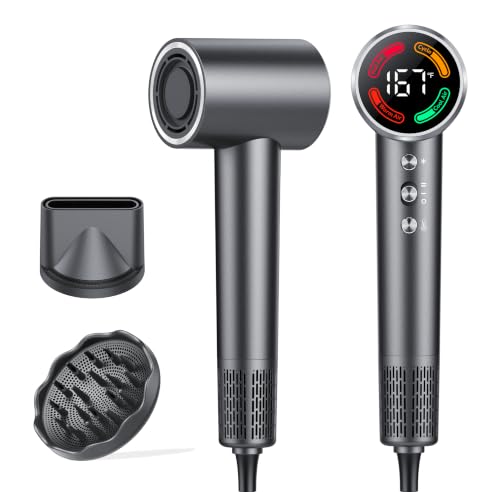
Hair Dryer, Mini High-Speed Blow Dryer with Diffuser, 500M Ionic Negative Blow Dryer for F
For thick or long hair dried daily. The brushless motor moves far more air, so hair dries in a fraction of the time and spends less total time under heat. That is the real damage argument, not the temperature setting.
- 【Professional Hair Dryer & 5X Faster Drying】This professional high-speed hair dryer is equipped with a...
- 【500 Million Negative Ions for Smooth,Shiny Hair】This high-speed ionic hair dryer features professional...
- 【9 Modes & LED Temperature Display】This high-speed blow dryer features multiple styling modes — Cooling,...
- 【360°RotationMagnetic Accessories & 8-Fold Noise Reduction Process】The hair dryer with diffuser and...
01The numbers, side by side
| Slikwave | FAMOO | |
|---|---|---|
| Price now | $17.99 | $59.99 |
| List price | $29.99 | $159.99 |
| Discount | 40% off | 63% off |
| Costs more | - | $42.00 |
| Price | $17.99 | $59.99 |
| Motor | Conventional brushed | High-speed brushless |
| Ionic conditioning | Yes | Yes |
| Diffuser | Not included | Included |
| Best for hair type | Short, fine, quick-drying | Thick, long, curly |
| Drying time | Standard | Substantially faster |
| Motor lifespan | Brushes wear over time | No brush wear |
| Travel friendly | Compact and light | Bulkier with attachments |
02Pros and cons
Slikwave- Under $20 - roughly a third the price for the same basic job
- Ionic technology is included, which is what breaks water down faster and cuts frizz
- Compact and light enough for a suitcase or a small bathroom drawer
- Simple controls, nothing to learn
- Conventional motor means noticeably less airflow, so thick hair takes much longer
- Longer drying time means more total heat exposure, which is the thing most people are trying to avoid
FAMOO- High-speed brushless motor moves far more air, cutting drying time substantially
- Less time drying means less cumulative heat damage even at the same temperature
- Brushless motors have no brush contact to wear down, so performance stays consistent for longer
- Ships with a diffuser, which matters if you have curls or waves
- Three times the price, and the benefit is small if your hair already dries quickly
- High-airflow dryers are often louder in pitch, even when not louder in volume
03The motor is the whole difference
Both of these are ionic dryers, so the marketing on the box looks similar. The difference sits in the motor. The budget dryer uses a conventional brushed motor, the same design that has been in hair dryers for decades. The $60 model uses a high-speed brushless one.
Brushless motors use electronic commutation instead of physical brushes making contact. There is nothing rubbing itself down, which means less wear and more consistent performance over years rather than months. More immediately, they spin far faster and move much more air.
That airflow is what you are actually buying. A high-RPM motor delivers stronger airflow and drastically reduces drying time - and that reduction is the point, not a bonus.
04Faster drying is a hair health argument, not a convenience one
Most people assume the way to protect hair is to turn the heat down. That helps, but it misses the bigger factor: how long the heat is applied.
Faster drying minimises heat exposure, which is crucial for preventing damage. A dryer that finishes in eight minutes at a given temperature has done meaningfully less to your hair than one that takes eighteen at the same setting.
This is why the price gap can be worth it for thick hair and pointless for fine hair. If your hair already dries in a few minutes, there is no exposure left to cut. If it takes twenty, you are halving something that actually matters.
05What ionic actually does, and why both have it
Ionic dryers emit negative ions that break water droplets down faster than heat alone, so hair dries quicker and with less frizz. It is a genuinely useful feature and the good news is that it has stopped being a premium one.
Both dryers here include it. That matters because it removes ionic conditioning from the decision entirely - you are not trading frizz control for price. You are only trading airflow.
If a dryer at this price does not list ionic technology, that is a reason to skip it rather than a reason to spend more elsewhere.
06Where the cheap dryer is genuinely the better buy
It is easy to write the budget option off, but there are situations where it is simply the correct choice. Travel is the obvious one - a compact, light dryer you would not mind losing beats an expensive one in a suitcase.
The second is a guest bathroom or a second home, where a dryer is used occasionally and speed is irrelevant.
The third is short hair. Under a certain length the motor stops being the limiting factor, and you are paying for capability you will never call on.
07Noise: the spec nobody checks until it is too late
High-airflow dryers are not always louder in raw volume, but they are usually higher in pitch. A brushless motor spinning at very high RPM produces a whine rather than the low roar of a conventional dryer, and some people find that harder to live with even at the same decibel reading.
This matters more than it sounds if you dry your hair early in the morning in a shared house, or with a sleeping baby nearby. It is worth knowing before you spend three times as much, because it is the one area where the cheaper dryer can genuinely be the more pleasant machine.
The flip side is duration. A higher-pitched dryer running for eight minutes may still be less disruptive than a lower one running for twenty. As with heat, total exposure counts for more than the peak number.
08How long each of these should last
Conventional hair dryer motors use carbon brushes that make physical contact to keep the motor turning. Those brushes wear down. It is the single most common reason a cheap dryer starts losing power after a year or two, long before anything visibly breaks.
Brushless motors remove that contact entirely and switch electronically instead. There is no brush to wear, so performance stays consistent rather than fading. That is the quiet argument for the more expensive dryer: not that it is faster on day one, but that it is still as fast on day eight hundred.
Whether that justifies the price depends on how often you use it. A dryer used twice a week may never reach the point where brush wear matters. One used daily almost certainly will.
09Attachments change what the dryer can do
A concentrator nozzle narrows the airflow into a focused stream. That is what makes a blow-dry hold its shape, and it is why the same dryer can feel professional in one person's hands and useless in another's. Without it you are pushing air in every direction at once.
A diffuser does the opposite - it spreads airflow wide and gentle so curl pattern sets rather than being blasted apart. The premium dryer here ships with one; the budget model does not. If you have any curl at all, buying a diffuser separately closes maybe fifteen dollars of the forty-two dollar gap.
Neither attachment is exotic and both are cheap to buy on their own. The point is to check what is in the box before assuming the cheaper dryer is a straight saving.
10When it makes sense to upgrade an existing dryer
If you already own a working dryer, the honest answer is usually to wait. A dryer that dries your hair in a reasonable time is not costing you anything by continuing to exist, and replacing it early is spending money to solve a problem you do not have.
Three things change that calculation. The first is a noticeable drop in power over time, which usually means brush wear and only gets worse. The second is a drying time that has crept past fifteen or twenty minutes as hair has grown longer. The third is heat damage you can see - dryness at the ends, more breakage than usual - because that is cumulative exposure showing up.
Any one of those makes the upgrade worth considering. None of them makes it urgent. The dryer that is already in your bathroom and works is rarely the wrong dryer.
11Which one fits you
Buy the cheap one. The premium dryer's advantage is speed, and you have nothing left to save. Spending $42 more to go from 8 minutes to 5 is not a real upgrade.
This is exactly what the brushless motor is for. Cutting a 20-minute dry to 10 saves you well over an hour a week, and halves the total heat your hair takes.
Counter-intuitively, the faster dryer is usually the gentler one. Damage tracks total heat exposure, so a dryer that finishes in half the time at the same temperature does less harm.
The included diffuser tips it. Diffusers spread airflow so curls set instead of frizzing, and buying one separately for the budget dryer erodes most of the price gap.
Consider the budget dryer, or at least go in knowing the trade. High-speed brushless motors run at a higher pitch that carries through walls, even when the overall volume is similar. A shorter dry helps, but the sound itself is sharper.
The cheap one is enough. Brush wear, cumulative heat exposure and time saved all scale with how often you use the dryer, and at twice a week none of them add up to $42 of difference.
Common questions
Is a brushless hair dryer worth the extra money?
It depends on your hair. For thick or long hair dried daily, yes - the stronger airflow cuts drying time substantially, which saves both time and cumulative heat damage. For short or fine hair that already dries quickly, the advantage largely disappears and the cheaper dryer does the same job.
Does a faster hair dryer damage hair more?
Usually the opposite. Damage tracks total heat exposure, so a dryer that finishes in half the time at the same temperature does less harm, not more. The risk with high-speed dryers is using the highest heat setting because you can, rather than the speed itself.
What does ionic mean on a hair dryer?
Ionic dryers emit negative ions that break water droplets into smaller ones, so they evaporate faster. The result is quicker drying and less static and frizz. It used to be a premium feature but now appears on dryers well under $20, including the budget option here.
Do I need a diffuser attachment?
Only if you have curls or waves. A diffuser spreads the airflow over a wider area so curl pattern sets rather than being blown apart into frizz. On straight hair it slows drying down for no benefit. The premium dryer here includes one; for the budget dryer you would buy it separately.
How many watts should a hair dryer have?
Wattage is a weaker signal than most shoppers assume. It measures power drawn, not airflow delivered, and a high-efficiency brushless motor can move more air at lower wattage than an older 1875W design. Look at motor type and airflow claims rather than the watt number on the box.
Is a $60 hair dryer as good as a $400 one?
For the core job, increasingly yes. Brushless motor technology that used to appear only in $400-plus dryers now shows up around the $60 mark. What the premium models still add is build quality, heat regulation and attachment range - real differences, but much smaller ones than the price gap suggests.
Should I use the highest heat setting to dry faster?
No, and it is the most common mistake made with a fast dryer. Heat and airflow both speed drying, but only heat damages the hair shaft. The right approach is high airflow at a moderate temperature, which is exactly what a high-speed dryer is built to deliver.
Do cheap ionic dryers actually produce ions?
Generally yes - the emitter is inexpensive, which is why the feature has spread to sub-$20 dryers. What varies is ion output, and that is not something manufacturers publish consistently. Treat ionic as a checkbox that should be present, not as a way to rank two dryers against each other.
Browse more in this category
Ready to pick one?
Prices shown are the ones we last saw on Amazon and can change at any time. Always confirm the current price on Amazon before buying. As an Amazon Associate we earn from qualifying purchases, at no extra cost to you.